

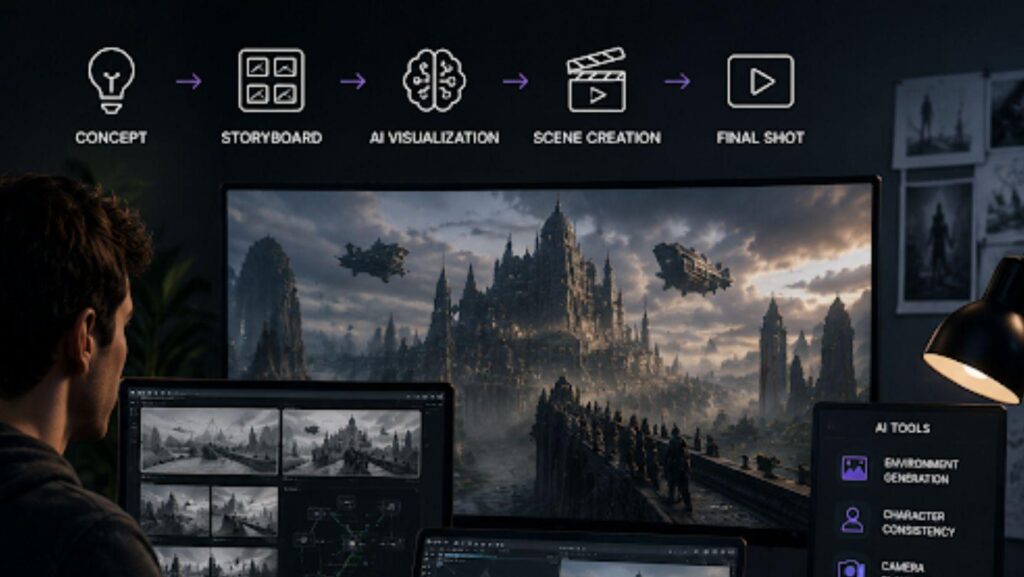
Creating complex scenes has always been one of the most challenging parts of filmmaking. Whether it is a large-scale action sequence, a fantasy world, a historical recreation, or a visually detailed commercial, filmmakers need to coordinate multiple creative elements at the same time.
A complex scene is not defined only by what appears on screen. It involves environment design, character movement, camera direction, lighting, visual effects, sound, and storytelling decisions working together. Traditionally, creating such scenes required large production teams, extensive planning, expensive locations, and significant post-production effort.
AI tools are changing how filmmakers approach this process. Rather than replacing traditional filmmaking techniques, AI is becoming a creative support system that helps directors and production teams visualize ideas, experiment with different approaches, and develop complex scenes more efficiently.
From early concept development to final production, AI-assisted workflows are helping filmmakers create scenes that were previously difficult, expensive, or time-consuming to produce.
Why Complex Scene Creation Is Challenging in Filmmaking
Complex scenes require many creative and technical decisions to work together. A filmmaker creating a large action sequence, for example, needs to consider how characters move through the environment, where the camera should be positioned, how lighting affects the mood, and how visual effects will blend with the practical elements.
Even a scene that appears simple to viewers may involve extensive planning behind the scenes. Directors, cinematographers, production designers, and VFX teams often spend significant time preparing before filming begins.
Traditional filmmaking relies on tools such as storyboards, previsualization, location planning, and technical rehearsals to reduce uncertainty. AI is now helping creators improve these early stages by allowing them to explore ideas faster and make creative decisions before production starts.
AI Helps Filmmakers Visualize Scenes Before Production
One of the biggest advantages of AI in filmmaking is its ability to support pre-production. Before cameras start rolling, directors need a clear understanding of how a scene should look, feel, and function within the story.
AI tools can help transform scripts, creative briefs, and visual references into early concepts that give filmmakers a clearer direction. A director can explore different environments, character designs, lighting approaches, camera compositions, and visual styles before committing resources to production.
This early experimentation is especially valuable for complex scenes because it helps teams identify creative challenges before they become expensive production problems.
AI-Powered Storyboarding and Shot Planning
Storyboarding has always been an important part of filmmaking because it allows directors to plan how scenes will be captured. However, creating detailed storyboards manually can take significant time, especially for productions involving complicated sequences.
AI-assisted storyboarding helps filmmakers explore different visual possibilities more quickly. Directors can experiment with shot compositions, character interactions, scene transitions, and camera perspectives before finalizing the production approach.
Rather than replacing the creative decisions of a filmmaker, AI provides a faster way to test ideas and communicate visual concepts with production teams.
For scenes involving multiple characters, complex environments, or detailed action choreography, AI-powered planning can make the entire production process more organized.
Creating Detailed Worlds and Environments
Building believable worlds is one of the most demanding aspects of filmmaking. Science fiction, fantasy, and historical productions often require environments that do not exist in reality, which means filmmakers must carefully design every visual detail.
AI tools are helping creators explore different versions of fictional worlds, including futuristic cities, fantasy landscapes, historical locations, and unique production designs.
These AI-generated concepts can serve as references for production design and visual effects teams. They allow filmmakers to test different directions and establish the visual identity of a world before investing heavily in development.
AI Helps Manage Complex Character Scenes
Scenes involving multiple characters require careful attention to continuity. Characters need to maintain consistent appearances, clothing, movement styles, and relationships with their surroundings throughout the story.
AI workflows are improving the ability to create and maintain digital characters across multiple scenes. This is particularly useful for virtual actors, animated characters, and AI-assisted films where the same character needs to appear repeatedly.
By maintaining character references and creative direction, AI helps filmmakers create characters that feel connected throughout a project instead of appearing as separate generations.
Creating Cinematic Camera Movements
Camera movement plays a major role in how audiences experience a scene. A slow tracking shot can create tension, while a wide cinematic shot can establish scale and atmosphere.
AI tools are helping filmmakers experiment with camera approaches before production begins. Directors can explore different framing styles, camera angles, movement patterns, and cinematic perspectives to understand what best supports the story.
This gives filmmakers more control over visual storytelling and helps them make stronger decisions before filming.
AI Helps Connect Multiple Creative Elements
Complex scenes often become challenging because different creative elements need to work together. A visually impressive environment may feel disconnected if the lighting style changes. A character may look consistent but feel unnatural if movement and camera direction do not match the overall tone.
AI filmmaking workflows are becoming more focused on maintaining connections between different stages of production.
Invideo Agent supports this type of connected filmmaking process by helping creators move from early concepts and scripts to visual development, scene creation, editing, and refinement. Instead of treating each stage as a separate task, it helps filmmakers develop a more unified workflow where storytelling, visuals, and production decisions remain connected.
This approach can be especially useful for complex scenes where characters, environments, and cinematic direction need to work together.
AI Agents Are Supporting Larger Production Workflows
As filmmaking projects become more ambitious, managing creative decisions across multiple departments becomes increasingly difficult.
A filmmaker working on a large project may need to maintain consistency across characters, locations, visual styles, camera direction, and effects. Keeping these elements aligned requires strong coordination throughout production.
With invideo Agent Two, advanced creative workflows can support larger projects by helping teams manage different aspects of production while maintaining a shared creative direction. It can assist with areas such as cinematography, story planning, casting decisions, and visual effects, helping filmmakers handle multi-scene productions where continuity and creative alignment are important.
AI Makes Visual Effects More Accessible
Visual effects have traditionally required specialized teams, expensive software, and significant production resources. AI is making certain aspects of VFX more accessible by helping filmmakers experiment with visual transformations, environment creation, scene enhancement, and background generation.
Independent filmmakers and smaller production teams can now explore ideas that may have previously required much larger budgets.
While professional VFX artists remain essential for high-end productions, AI tools provide creators with more flexibility during development and experimentation.
Creating More Realistic Action and Movement
Action scenes require careful coordination between character movement, camera work, environments, and visual effects.
AI can help filmmakers explore movement ideas, choreography concepts, crowd scenes, dynamic camera sequences, and complex visual moments before production begins.
By testing these elements early, filmmakers can better understand what works and where challenges may appear. This allows production teams to use their time and resources more effectively.
AI Enables Faster Creative Experimentation
One of the biggest advantages of AI in filmmaking is the ability to explore more creative possibilities in less time.
A director can experiment with different versions of a scene, including alternative environments, lighting styles, character designs, and camera approaches.
This flexibility allows filmmakers to refine their vision before production begins. Instead of choosing between a limited number of expensive options, creators can explore a wider range of creative directions.
Human Creativity Remains the Foundation of Filmmaking
Although AI can support complex scene creation, storytelling decisions still depend on human creativity.
Filmmakers decide what emotion a scene should create, how characters should behave, what visual style fits the story, and how audiences should experience the moment.
AI works best as a creative partner that helps reduce repetitive work and expands the possibilities available to filmmakers.
The strongest results come from combining AI capabilities with human direction, imagination, and storytelling expertise.
The Future of AI-Assisted Complex Scene Creation
AI is moving filmmaking toward more flexible and accessible production workflows. As these technologies continue to improve, creators will have more opportunities to develop detailed worlds, realistic characters, and ambitious cinematic sequences.
The future of filmmaking will likely focus less on creating isolated visuals and more on building complete experiences where characters, environments, camera movement, sound, and storytelling work together.
Final Thoughts
Complex scene creation has always required careful planning, technical expertise, and creative vision. AI tools are changing this process by helping filmmakers visualize ideas, maintain consistency, and experiment with ambitious concepts faster.
From pre-production planning and world-building to character development and cinematic direction, AI is becoming an important part of modern filmmaking workflows.
The goal is not to replace traditional filmmaking but to expand what creators can achieve. By combining AI-assisted production with human storytelling, filmmakers can bring more complex and imaginative scenes to life.