


Sometimes, the most powerful movement is the kind that never happens. A still poster that seems to breathe, a flyer that feels like it’s mid-spin, or a banner that sways softly in your mind of these play with the illusion of motion. They tell stories without ever needing to move. With modern design tools like Dreamina, artists can now create posters that don’t just speak-they whisper emotion through stillness. The AI image generator within Dreamina helps creators merge subtle blur, composition, and light into flat designs, turning them into dynamic experiences.
This isn’t about animation. It’s about tricking the eye and enchanting the brain-turning a printed sheet into a living moment.
When silence moves: the hidden rhythm of still design
A really engaging poster doesn’t rely on motion graphics; it relies on psychological rhythm. Human eyes are wired to follow implied motion: a figure leaning forward, a ribbon caught mid-air, a swirl of light suggest continuity. The design might end, but the story doesn’t.
What makes such posters mesmerizing is the tension between what’s there and what could be. A dancer frozen mid-twist still makes you anticipate the spin. A falling leaf caught halfway down still reminds you of gravity’s pull.
Designers apply this to:
- Suggest direction by using angled elements, perspective, or diagonal composition.
- Create focus with light trails, soft gradients, or blurred edges.
- Add narrative with body posture, fabric flow, or cascading text.
The best posters don’t move — they feel like they’re about to.
Resonating energy: How emotion shapes illusion
Emotion plays the leading role in creating that illusion. The real point is not the movement by itself. It is what that movement represents. Think excitement, urgency, freedom, chaos all wrapped up in it. For instance:
- Take a jazz poster for instance. It might swirl with diagonal shadows and broken geometry. Those elements echo the improvisation that defines the music.
- Or consider a theater promotion. It could freeze a performer right in mid-jump. That suspends the anticipation in a powerful way.
- Then there is a sports flyer. It would add motion blur straight onto the typography. This captures velocity even within the words themselves.
All of this adds up to emotional engineering in design. Still images start to feel truly alive because of it. Viewers often do not notice the technique on purpose. Still, it pulls them in every time.
The poster becomes an echo visual hum that continues long after they look away.
Cinematic composition: when posters borrow from film
Here’s where it gets especially fascinating: posters that borrow cinematic grammar. Filmmakers use leading lines, framing, and dynamic angles to direct attention. Designers, inspired by that visual storytelling, replicate those same cues.
A poster that resembles a film still can’t help but feel in motion. It automatically invites the imagination to fill in what happened before and what will happen afterwards. Designers will often depend on:
- Foreground depth: blur one area to create an illusion of focus.
- Directional light: imitating sun rays or headlights to direct the viewer’s attention.
- Layered composition: It allows you to stack layers over each other to create the effect of parallax motion.
The viewer’s brain completes the motion; the 2D picture comes alive as a story.
Beyond the frame: How video generation takes it further
The beauty of movement illusion need not end in print. With the AI video generator, you can take your still posters and evolve them into living vignettes. Think about transforming a music poster where light flickers softly, or a festival flyer where confetti drifts in the air.
Dreamina makes that transformation effortless: a bridge between static design and cinematic presence. You can animate depth, highlight emotional cues, or make text flow like choreography. This isn’t full animation; this is about giving a heartbeat to the visual moment you have just created.
Through subtle motion, your once static story becomes immersive; the whisper turns into a sigh.
Dreamina’s design flow: where stillness learns to move
Step 1: Write a detailed text prompt
Go to Dreamina and start by setting your intent. Describe the illusion you want to make: movement that isn’t there. Be specific with light, form, and tone.
For example, you might write: A poster of a dancer in mid-turn, with a flowing red dress trailing behind; soft, gold light; blurry edges of motion; minimalist background; emotional and cinematic in feel.
The more you imagine vividly, the more precisely Dreamina can translate that into design.
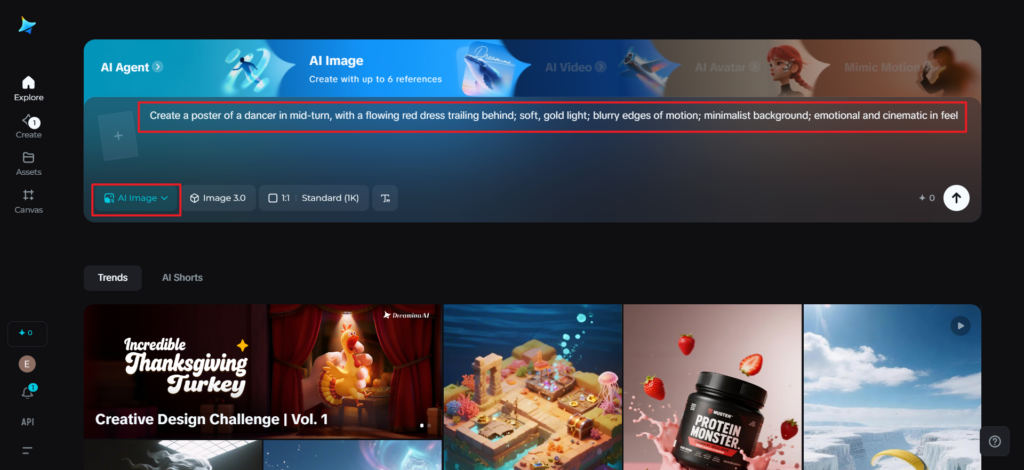
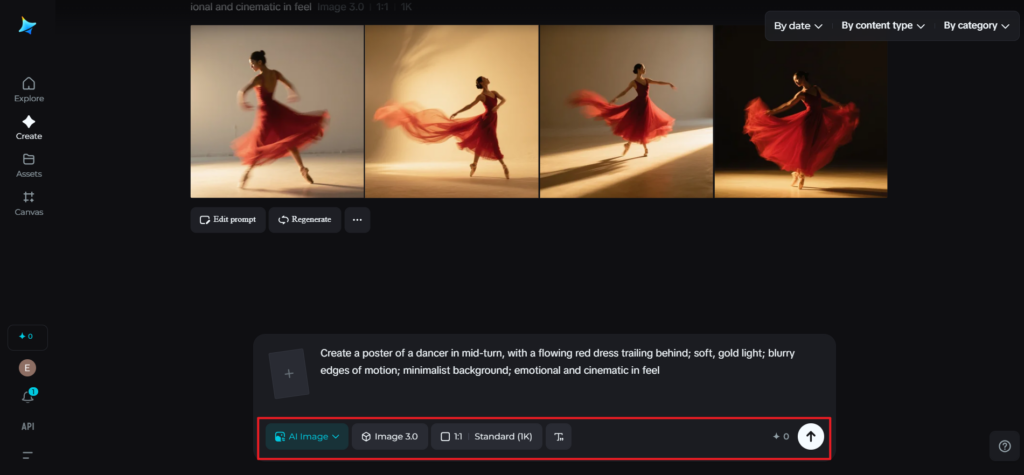
Step 2: Tweak settings and generate
Refine your creation: Choose your model, aspect ratio, and size-whether you’re designing for a vertical print, widescreen banner, or square social post. Adjust the resolution between 1k and 2k for sharp detail, then tap Dreamina’s glowing icon to generate your poster. Within seconds, you’ll see a still image that moves in feeling if not in pixels.
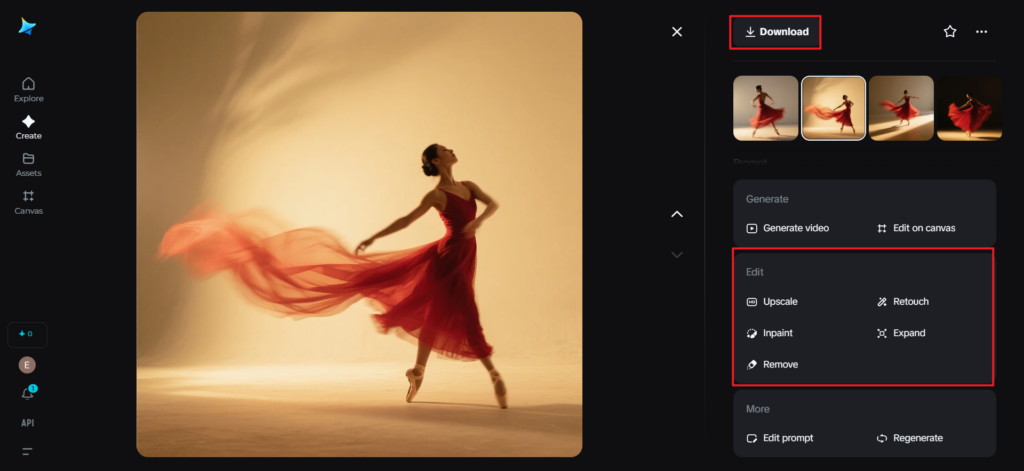
Step 3: Customize and download
Refine it with the customization features offered by Dreamina: inpaint the edges, expand to give more flow to the background, remove distractions that may be there, or retouch the light to perfect the illusion of depth. Click the Download icon when you are satisfied, save your creation, and share it across print and digital channels.
Textured time: when AI art remembers motion
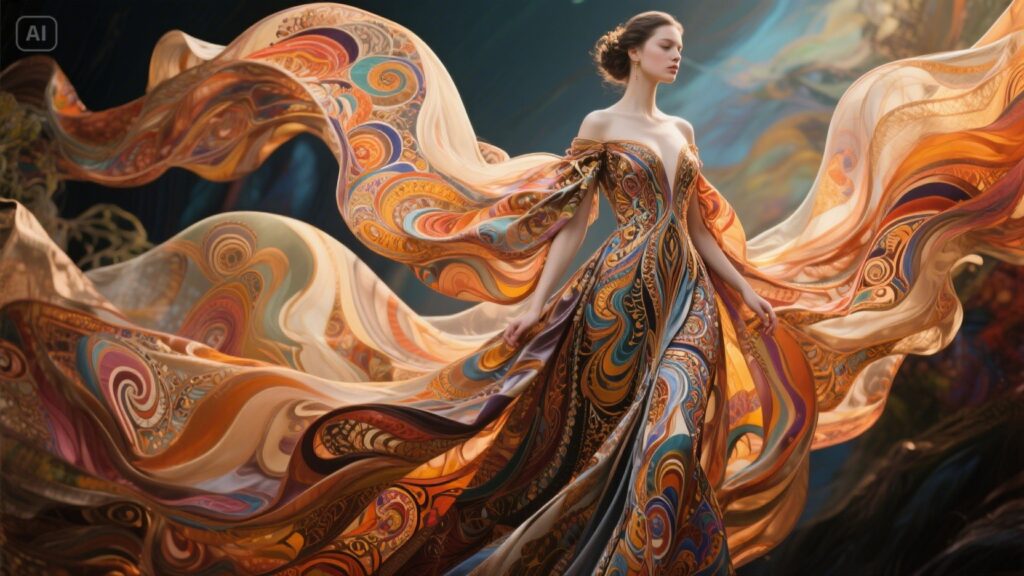
Every poster, even one that’s perfectly still, carries traces of motion-brush strokes, gradients, asymmetries. And the AI art generator helps designers play with that memory of movement. It can simulate the tactile blur of motion photography or the brushed softness of impressionist art. These micro-imperfections invite emotion.
What is more fascinating, however, is how Dreamina allows a balance between control and chaos. An artist sets a direction, while AI can add subtle unpredictability-a tilt of light, a swirl of fabric-making an illusion breathe more naturally.
In visual marketing, this gives brands a new storytelling language. A campaign doesn’t have to flash or spin in order for it to be dynamic; it just has to hum quietly with life.
Conclusion: Where silence speaks the loudest
That whispering poster does not go against itself at all. It really celebrates the simplicity of design. The thing is, it proves that something can still touch people right in the heart. A fixed image like that can almost throb with its own beat. Even a quiet setup in the layout speaks way louder than any fast-moving blur. Dreamina lets creators mix up the edge between plain sight and deeper feeling. They combine light, surface feel, and the story behind it all. Viewers end up sensing motion in spots where nothing actually shifts.
Dreamina works through its AI tool for making images or using its strong editing features. It hands designers ways to craft prints that carry a subtle kind of power. The most impactful tales do not always yell out loud. They just murmur instead.