

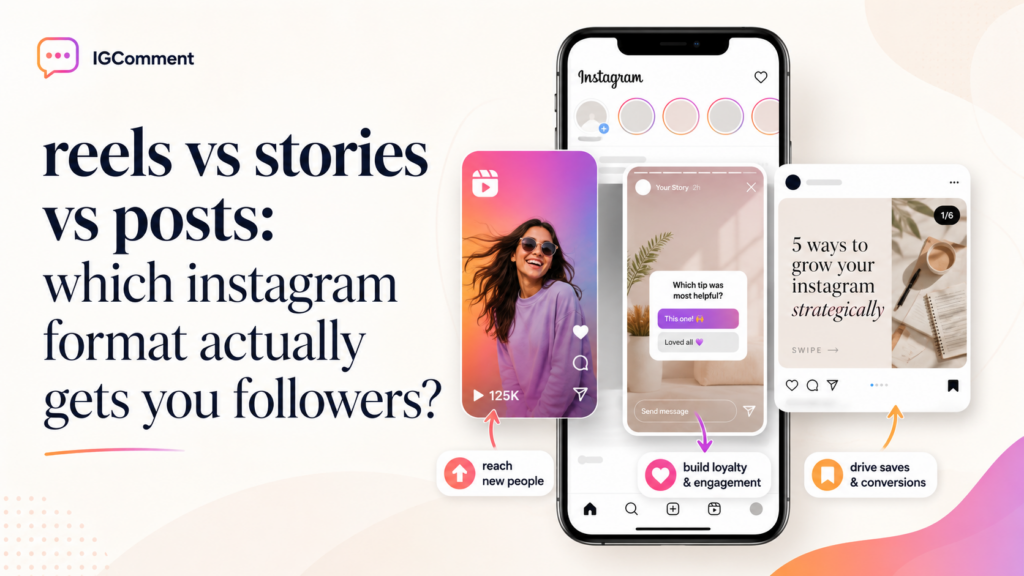
You spend two hours editing a Reel, post it, and watch it pull 3,000 views from total strangers – and zero new followers. Meanwhile, a throwaway Story poll from yesterday got you eight DMs from people who actually follow you now.
You’re not wasting your time. You’re spending it on the wrong format for what you’re trying to do. Reels, Stories, and feed posts are three different machines that do three different jobs. Using Reels to build loyalty is like using a billboard to make friends; using Stories to get discovered is like whispering in a stadium.
Here’s which one does what, and how to stop guessing.
The Quick Version
|
You want |
Reels |
Stories |
Carousels |
Single images |
|
New followers |
Best |
Indirect |
Decent |
Weakest |
|
Loyalty & DMs |
Low |
Best |
Good |
None |
|
Reach past your followers |
Wide |
10-30% of followers |
Medium |
Fading |
|
Lifespan |
Days+ |
24 hours |
Days |
A day or two |
|
What the algorithm reads |
Shares, watch time |
Replies, sticker taps |
Saves, swipe depth |
Likes, weakest |
Reels get you found. Carousels hold the highest engagement of any format. SocialInsider puts carousels at about 0.55% versus 0.52% for Reels, with single images trailing well behind. Stories build the relationships that make everything else work.
Single images still have a place, but they are usually the weakest format for follower growth unless the image carries real news, emotion, or visual value.
Reels: The Discovery Engine
If you’re under 10,000 followers, Reels aren’t optional – they’re your main way to get found. They live on Explore and the Reels tab, two surfaces built for showing your content to people who don’t follow you yet. The signal that matters most here is the share: a Reel people send to a friend is a Reel the algorithm is more likely to push wider.
Length trips a lot of people up. For pulling new followers, the 15-30 second range usually works best: long enough to land a point, short enough that nobody bails halfway. Longer videos can work for depth, but they often serve people who already know you better than people discovering you for the first time.
And it all hangs on the first three seconds. View, watch, profile tap, scroll your grid, follow – every step in that chain depends on not getting swiped past in second one. A strong hook on the same content can double how many viewers actually become followers.
Stories: The Relationship Builder Nobody Talks About
Stories don’t reach new people. They usually show to a smaller slice of the followers you already have. That sounds like a downside until you see what Stories are for: turning quiet followers into people who message you.
Polls, questions, quizzes, sliders – every tap is a direct interaction between two accounts, and that is exactly the signal Instagram reads as ‘these two have a relationship.’ The payoff is not a follower count that jumps overnight. It is that your existing followers start seeing more of your Reels and posts, engage more, and create the early activity that makes new visitors trust you enough to follow.
Keep daily Stories to a few slides so people finish them, lean on at least one interactive sticker, and end with something that invites a reply. For a small account, posting Stories with stickers every day teaches the algorithm that your account starts conversations.
Carousels: The Quiet Converter
Here is the one that surprises people: carousels often hold the highest engagement rate of any format. The trick is the swipe. Each slide someone swipes is another interaction, and if they do not finish, the algorithm can re-serve the unswiped slides later. One carousel gets several shots at the same person. More swipes, more profile visits, more follows.
Carousels also pull saves, one of the strongest signals you can earn, because a save tells Instagram the content is worth coming back to. The followers who arrive this way tend to stick. They did not follow over one fun clip. They followed because your content showed it was worth keeping.
Teaching carousels – step-by-steps, breakdowns, before-and-afters – usually beat entertainment-only ones on saves.
The Thing That Helps Any Format
Every format works better with a little early engagement. The algorithm tests a post that already has some activity differently than one sitting at zero – and that is true for Reels, Stories, and carousels alike.
If ‘just post good content’ feels hollow when nobody is seeing it yet, that is fair. What matters is how the first engagement arrives: signals that spike and flatline get read differently than signals that look like a real discovery pattern.
A paced boost from Instagram likes can help a strong Reel or carousel look active early, but it works best when the content already has a reason to travel. Each format responds to timing differently, and pacing the delivery to match the format is what makes the difference. Test it on one post and compare the reach to your usual.
What to Post Today
Stop asking “what should I post?” and start with “what am I trying to do right now?”
Want new followers and you are under 10K? Post a Reel: 15-30 seconds, best hook up front, with a clear reason to tap your profile.
Want your existing followers more engaged? Run Stories: a few slides, interactive stickers, and a final question that can lead to a DM.
Want to turn profile visitors into followers? Post a carousel: teach something, make slide one a hook, and make the last slide worth saving.
Just keeping presence while you work on bigger content? Post a quick Story. Show your face, show the process, no editing required.
Testing a risky idea? Post it as a Story first. Strong sticker response means it can become a Reel; if it flops, it disappears in 24 hours.
Under 500 followers? Post Reels three to four times a week plus daily Stories. Skip feed posts until you have an audience to serve them to. Your job right now is discovery, and Reels are the format that delivers it at your size.
Reels find followers, Stories keep them, and carousels convert them. The accounts that grow fastest are not the ones posting the most. They are the ones posting the right format for the goal in front of them.