


Content teams are stretched thin. Between keyword research, drafting, optimizing, and publishing, a single blog post can take a full day.
Contentpen promises to compress that entire workflow into one autopilot run. We tested the platform to see if it delivers, what it does well, and where it falls short. We will also see whether the pricing makes sense for brands and creators in this Contentpen review.
Key takeaways
- Contentpen is an AI writing platform built for both traditional SEO and the newer world of AEO (answer engine optimization), so your content can rank on Google and get cited by tools like ChatGPT and Gemini.
- Its standout feature, Autopilot, takes a single keyword and runs the entire pipeline: title, secondary keywords, SERP-informed writing, internal linking, branded images, external sourcing, and publishing.
- Plans start at $39/month billed monthly, which is genuinely competitive once you factor in what’s bundled: SEO scoring, AEO/GEO scoring, AI visibility tracking, and website analytics.
- Backlink building is not part of the package, so brands chasing domain authority will need a separate tool or agency for outreach.
What Contentpen actually does
Contentpen positions itself as an AI agent for content, not just a text generator. Most tools hand you a draft and stop there, while Contentpen’s agents research, write, optimize, publish, and improve a post end to end.
In practice, that means the platform pulls keyword data, runs competitor and SERP gap analysis, clusters topics, writes a full draft, scores it for search and AI visibility, adds links and images, and pushes it live to your CMS.
That’s a lot of ground to cover, and for the most part, it holds up. The dashboard is clean, and every stage of the pipeline is visible, so you’re not left guessing what the AI did to your draft.
Autopilot is the feature that sells this tool
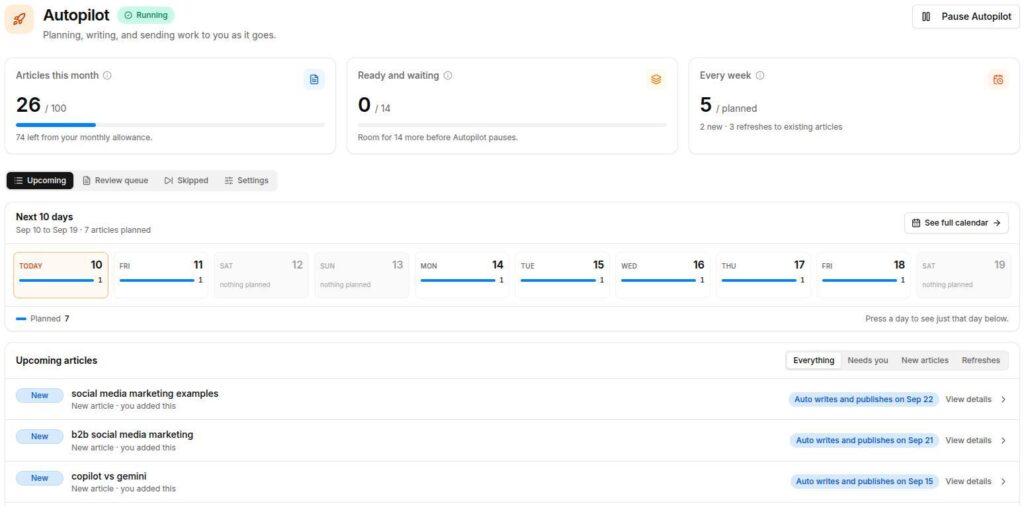
The genuine standout here is Autopilot. Feed the tool one keyword, and it handles the rest.
It starts with title creation, generates secondary keywords, builds a full draft based on real SERP analysis, places internal and external links, adds branded images, and enables one-click publishing.
For a solo marketer or a small team without a dedicated SEO specialist, this is where the time savings actually show up.
Instead of switching between five tools, Autopilot chains it all into a single run. You can also take the two-step route and review the outline before the full draft is written, or start from a blank page and write alongside the AI.
That flexibility matters because full automation isn’t right for every workflow, and Contentpen doesn’t force you into it.
AEO and GEO: Built for a search landscape that’s changing
Alongside standard SEO scoring, every draft gets a GEO (generative engine optimization) score, which estimates how likely the content is to get cited by AI answer engines like ChatGPT and Gemini.
Layered on top of that is AI visibility monitoring. It is a dashboard that tracks how often your brand actually gets mentioned or cited across those AI engines, along with share of voice, sentiment, and average position.
Brands have spent years optimizing for Google’s SERPs. Now that a growing share of search happens inside AI chatbots instead of a results page, having this kind of visibility built into the same platform you write on is a real advantage.
SEO opportunities and website analytics
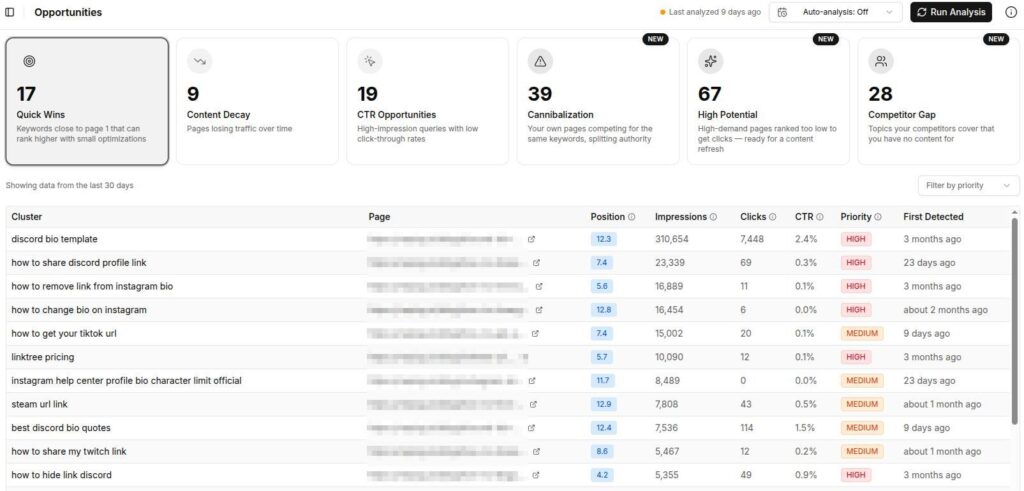
Contentpen also connects to Google Search Console, so you can track clicks, impressions, CTR, and rankings without leaving the platform.
The SEO opportunities feature automatically flags quick wins, CTR gaps, and posts that are decaying in rankings, then lets you refresh that content with AI in a single click.
This is the kind of feature that usually lives in a separate, more expensive analytics tool. Having it bundled in means you’re not just generating content and hoping it performs. You get a feedback loop that tells you what to fix and lets you fix it immediately.
Pricing: Does $39 a month hold up?
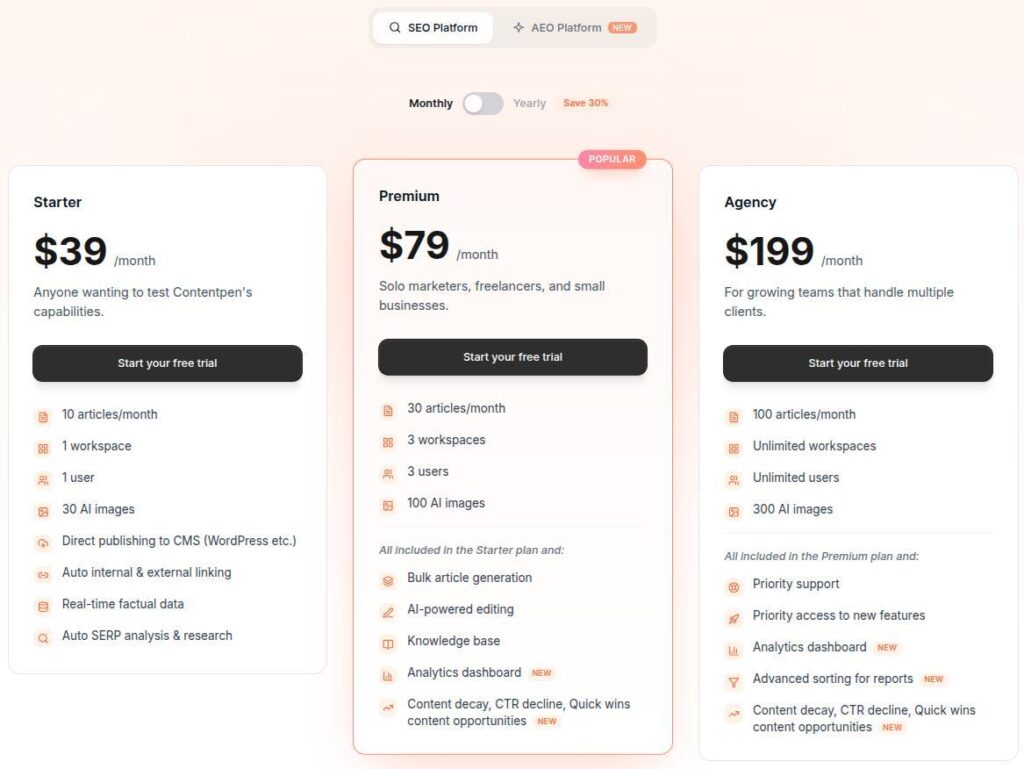
Contentpen’s entry-level Starter plan runs $39/month billed monthly (or less if you commit annually), and it covers 10 articles, auto SERP research, internal and external linking, and direct CMS publishing.
The AEO/visibility side has its own comparable entry tier, also starting around $39/month, covering AI visibility tracking across 2 AI models with weekly reporting.
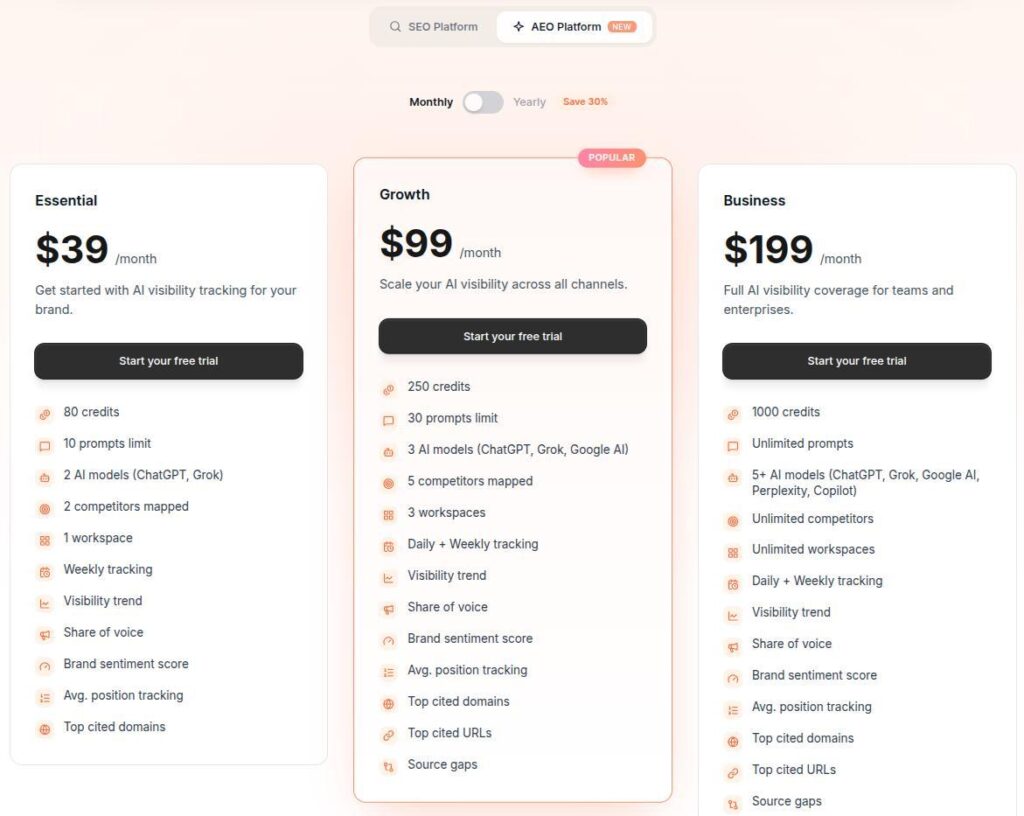
At this price, Contentpen genuinely provides good value to SEO/AEO professionals and enterprises.
Premium and Agency tiers scale up article volume and workspaces and add bulk generation and analytics, which makes sense for agencies managing multiple clients.
You can avail of the 7-day free trial to test the AI writer before purchasing.
The honest pros
After testing and going through user reviews, these were the Contentpen pros identified:
- Autopilot genuinely removes the manual grunt work between a keyword and a published post.
- Bundling SEO and AEO/GEO scoring in one platform is ahead of where most competitors are right now.
- The content decay and quick-win detection turn the platform into an ongoing optimization tool, not just a writer.
- One-click publishing to WordPress, Webflow, Shopify, Ghost, Em-Dash, and Wix removes the copy-paste step most AI writers leave you with.
That said, Contentpen does come with its shortcomings.
The honest cons
Below are the honest drawbacks felt after trying the system:
- There’s no free plan available
- The trial requires a credit card upfront
- There’s a learning curve. Between SEO scoring, GEO scoring, keyword clustering, and analytics, new users will need a session or two before the dashboard feels intuitive.
- No backlink building features are available in the tool
Regardless, the AI blog writer does help in boosting organic traffic and enhancing AI visibility for businesses.
Conclusion
Contentpen isn’t just another AI drafting tool. The combination of Autopilot, GEO scoring, AI visibility tracking, and built-in content refresh makes it one of the more complete platforms for brands trying to win both AEO and SEO.
At $39 a month, it’s priced fairly for what’s bundled in, and the lack of a free plan or no-card trial is a fair trade-off if the workflow fits how your team actually creates content.