


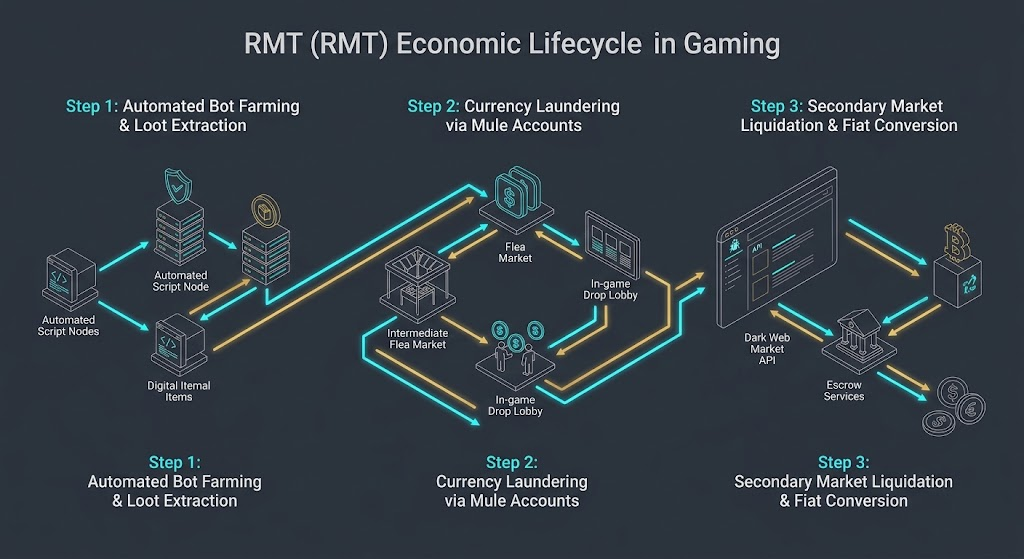
Real Money Trading (RMT) represents the exchange of virtual in-game currencies, rare items, character accounts, and progression services for real-world fiat currency. What began in the late 1990s as casual secondary-market auctions on platforms like eBay has matured into a multi-million-dollar shadow industry spanning extraction shooters, massive multiplayer online games (MMORPGs), and competitive survival sandboxes. As player demand for instant progression and high-tier loadouts surged, manual grinding was displaced by industrial farming operations, automated market sniping scripts, and specialized Escape from Tarkov cheats.
Key Takeaway: Modern RMT has evolved from low-wage manual labor into algorithmic infrastructure. Operators rely on telemetry manipulation, headless client clusters, and memory-reading overlays to extract high-value assets and liquidate them before detection algorithms trigger account flags.
1. The Evolution of RMT: From Gold Farms to Extraction Economies
The foundational model of RMT originated in subscription-based MMORPGs such as RuneScape, Ultima Online, and World of Warcraft. In these ecosystems, the primary commodity was in-game currency earned through repetitive, time-intensive loops—often operated by physical labor farms in low-wage regions or rudimentary headless macro bots. Economic equilibrium was maintained primarily through hard gold sinks, such as mount costs, repair bills, and auction house fees.
The emergence of extraction shooters—most notably Escape from Tarkov, Arena Breakout: Infinite, and Dark and Darker—revolutionized RMT economics. Unlike traditional MMOs where items remain permanently bound to a character, extraction games implement full-loot or high-friction loss mechanics. When a player risks total gear loss on every deployment, the perceived utility of immediate wealth replacement spikes exponentially. RMT operators shifted focus from bulk gold accumulation to high-value-density loot extraction, specialized keys, and weapon meta builds.
2. The Technical Infrastructure of Industrial Farming
Modern RMT does not rely on human players slowly looting virtual crates. Professional operations operate structured technical pipelines designed to maximize roubles, gold, or scrap per hour while minimizing operational hardware overhead.
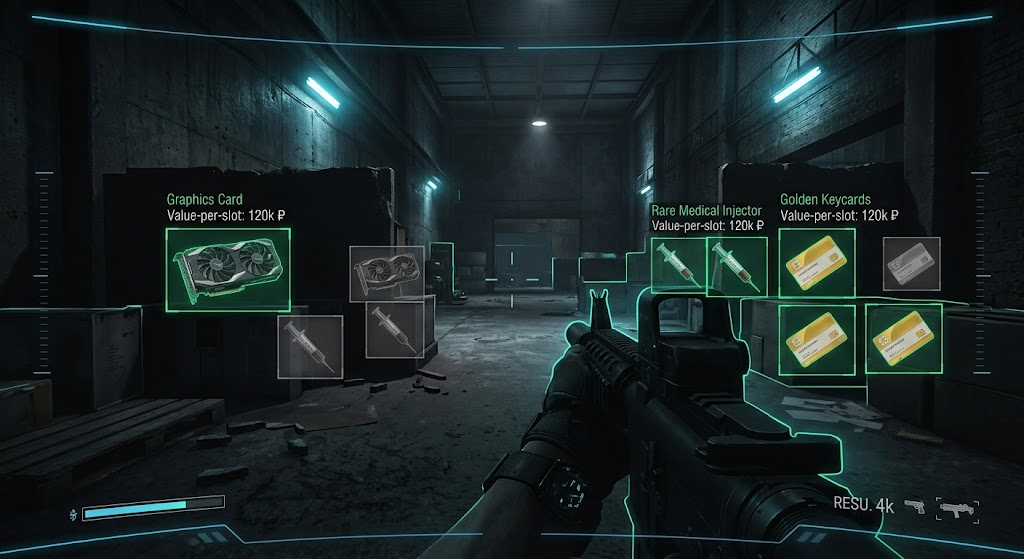
- Item ESP and Value-per-Slot Filtering: In tactical shooters, time spent looting low-tier items reduces survivability and throughput. Specialized item filters scan game memory to display only high-tier items (such as LEDX, GPUs, or colored keycards) through terrain, allowing farmers to sprint directly to target spawns and extract within minutes.
- Headless Game Clients and Bot Clusters: In titles with auction houses, headless game processes running on virtualized servers automate market arbitrage, buying underpriced items milliseconds after listing and reselling them at margin.
- Carry Services (Sherpa / Chaperone Raids): To circumvent strict item drop limitations, RMT operators offer live raid escort services. A customer enters a match alongside an operator who eliminates all hostile players on the map, allowing the buyer to safely extract with map-wide high-value loot.
- Mule Accounts and Drop Laundering: Direct peer-to-peer transfers are heavily monitored by game telemetry. Operators use disposable mule accounts to scatter currency through complex market trades, intentionally matched matchmaking lobbies, or rigged in-game barter mechanics.
3. Economic Breakdown Across Game Genres
|
Genre |
Primary Traded Assets |
Farming Methodology |
Primary Detection Vector |
|
Extraction Shooters |
Rare keys, high-tier armor, currency, raid carries |
Loot ESP speed-runs, raid wipes, market trade arbitrage |
Survival rate anomalies, abnormal item pickup timestamps |
|
MMORPGs |
Gold, raid powerleveling, mythic gear mounts |
Automated pathfinding bot loops, mob grinding farms |
24/7 uptime telemetry, repetitive input polling |
|
Survival Sandboxes |
Base blueprints, sulfur/explosives, high-end components |
Resource node ESP, speed farming, offline raid automation |
Resource accumulation velocity, clan inventory transfers |
|
ARPGs (Loot Slasher) |
Crafting orbs, mirror tier items, boss kill services |
Multi-instance map farming scripts, trade message bots |
Unbalanced trade window exchanges, client injection logs |
4. Countermeasures and the War on Game Economy Inflation
Unregulated RMT poses an existential threat to game design. Massive currency injection triggers hyperinflation, pricing legitimate casual players out of auction markets and eroding retention. To combat this, modern game studios implement layered defensive protocols:
- Trade Restrictions and Status Binding: Systems like “Found in Raid” (FIR) prevent players from immediately reselling items brought into a raid by third parties or purchased on the flea market.
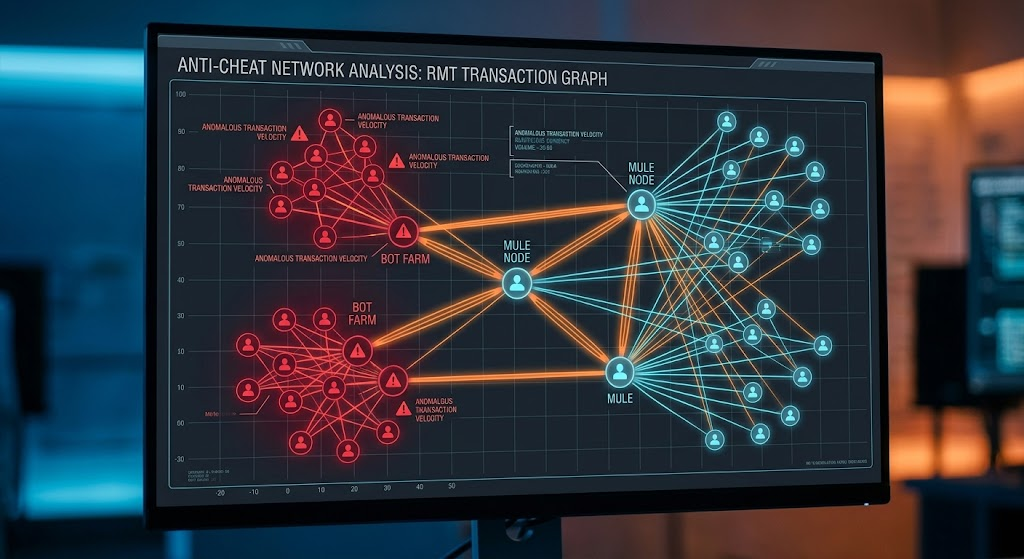
- Behavioral Economic Telemetry: Server-side heuristics monitor trade delta values. If two players trade 10,000,000 gold for a single low-tier ammo round, automated anti-fraud triggers flag both accounts for review.
- Dynamic Fee Scaling and Market Taxes: Exponential sales taxes punish price manipulation, draining excessive currency from active circulation.
- Hardware and Account Verification: Mandatory phone verification and hardware identity bans (HWID) limit the lifespan and profitability of disposable farming botnets.
5. Frequently Asked Questions
Why is RMT banned in almost every online game?
RMT destabilizes game economies through rampant currency inflation, incentivizes account theft and botting, bypasses designed gameplay loops, and directs monetization revenue away from developers toward unregulated black markets.
How do anti-cheat systems track down RMT sellers?
Security teams combine client-side integrity scanning (detecting injection scripts and item ESP) with server-side economic graphs that map anomalous wealth distribution between disconnected player clusters.
Can buyers get banned for purchasing in-game items?
Yes. Transaction tracking algorithms trace the flow of currency directly from flagged bot hubs to recipient accounts, frequently resulting in permanent account bans, inventory wipes, or negative currency balances.