

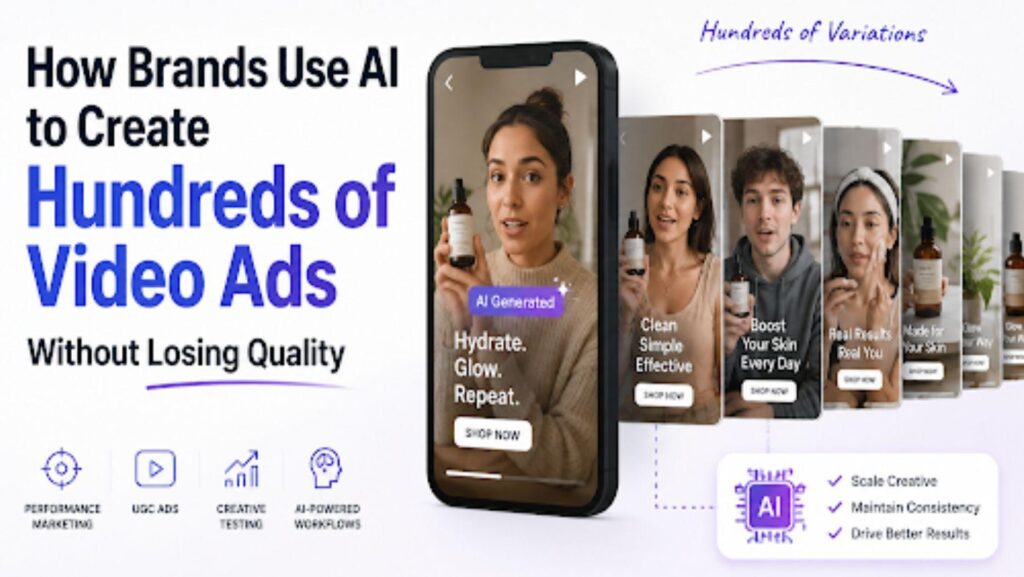
Creating one strong video ad is difficult. Creating dozens or even hundreds of ad variations without losing quality is much harder.
Performance marketing teams need a steady flow of fresh creative. Different audiences respond to different hooks, offers, product angles, creators, and visual styles. At the same time, platforms like TikTok, Instagram, YouTube, and other paid channels reward frequent testing, which means brands cannot rely on a small set of ads for long.
AI is changing how brands handle this pressure. Instead of treating every ad as a separate production, teams can now build repeatable creative systems that help them generate, test, and refine large volumes of video content while maintaining brand consistency.
The key is not simply producing more ads. It is creating more useful variations without letting quality, messaging, or visual identity fall apart.
Why Performance Marketing Needs More Creative Than Ever
Paid social campaigns often depend on creative testing.
A single campaign may require variations based on:
- Different opening hooks
- Product benefits
- Audience segments
- Creator styles
- Ad lengths
- Visual formats
- Calls to action
- Offers and promotions
The same core product message may be tested across multiple versions to understand what performs best.
This creates a major production challenge. If every variation requires a new shoot, new creator, new edit, and new approval cycle, the process becomes slow and expensive.
AI helps reduce this burden by making it easier to create structured variations from the same campaign idea.
AI Makes Creative Testing Faster
One of the biggest advantages of AI in advertising is speed.
Performance teams can use AI to explore several versions of the same idea before committing to a final direction.
For example, a skincare brand may test:
- A problem-solution ad
- A testimonial-style UGC ad
- A product demonstration
- A before-and-after concept
- A creator-led talking-head format
- A cinematic product-focused version
Instead of starting from zero each time, AI can help adapt the same campaign idea into different creative formats.
This allows teams to test more angles while keeping the underlying product message consistent.
UGC Ads Are Easier to Scale With AI
UGC-style ads work because they feel personal and direct. They often resemble creator content rather than traditional advertising.
However, producing UGC at scale can be difficult. Brands may need to coordinate with many creators, collect footage, manage revisions, and keep messaging aligned.
AI can help create UGC-style variations using:
- AI actors
- Digital presenters
- Script variations
- Product-focused scenes
- Voice generation
- Localized versions
This gives performance teams more flexibility when they need new creative quickly.
AI-generated UGC does not replace authentic creator content in every case, but it gives brands another way to expand their creative testing without depending entirely on manual production.
Scalable Campaign Workflows Matter More Than Single Generations
The biggest shift is moving from one-off generation to connected campaign workflows.
A brand producing hundreds of ads needs more than a tool that can generate one video at a time. It needs a system that can keep campaign decisions connected across multiple outputs.
This is where invideo Agent fits naturally into performance marketing workflows. It can help teams move from briefs and campaign ideas into complete video projects while keeping creative context connected across different versions.
For example, a team can develop a campaign around a specific product, audience, visual direction, and message, then create multiple variations without rebuilding the entire creative foundation each time.
With invideo Agent Two, project memory and specialized creative agents can help maintain decisions around characters, visual style, casting, cinematography, storyboarding, and VFX across larger campaigns. This becomes useful when brands are producing many ads that need to feel different enough for testing while still belonging to the same campaign.
Maintaining Brand Consistency Across Hundreds of Ads
Scaling creative does not mean every ad should look identical.
The goal is to maintain the parts that define the brand while allowing enough variation for testing.
Consistency can include:
Product Appearance
The product should remain recognizable across different scenes and formats.
Brand Colors and Visual Style
Lighting, color treatment, and design choices should stay aligned with the brand identity.
Tone of Voice
Scripts can vary, but the overall personality of the brand should remain familiar.
Messaging
Different ads may focus on different benefits, but the core product positioning should remain clear.
AI can help teams reuse these creative rules across multiple outputs.
Why Creative Variation Still Needs Structure
Generating more content is easy. Generating meaningful variation is harder.
If every ad is only a slightly different version of the same creative, testing becomes less useful.
Strong creative testing usually changes one or more important variables:
- The hook
- The spokesperson
- The product angle
- The emotional tone
- The visual setting
- The call to action
- The pacing
- The format
This gives marketers clearer signals about what audiences respond to.
AI works best when teams define these variables before generation rather than producing random variations.
AI Actors Help Brands Test Different Creative Personas
AI actors are becoming useful for campaigns where brands want to test different creator styles without organizing separate shoots.
A product can be presented by:
- A casual lifestyle creator
- A professional expert
- A younger audience-focused presenter
- A premium brand spokesperson
- A direct-response style performer
Each version can communicate the same product in a different way.
This helps brands understand which personality, tone, or presentation style performs better with different audiences.
Consistency remains important here. If the same AI actor appears across several ads, the face, voice, style, and overall presentation should remain recognizable.
Product Consistency Is Critical in AI-Generated Ads
Product-focused advertising creates another challenge.
If the shape, packaging, color, logo, or proportions of a product change between scenes, the ad immediately feels unreliable.
Brands creating AI-generated ads should maintain consistent references for:
- Product design
- Packaging
- Labels
- Colors
- Materials
- Size and scale
This is especially important for ecommerce, beauty, fashion, consumer electronics, and packaged goods.
A strong AI workflow should make it easier to carry the same product identity across multiple shots and ad variations.
Localization Becomes Much Easier With AI
Scaling ads often means scaling across regions.
Traditionally, localization may require new voiceovers, new edits, subtitles, or even new shoots.
AI can simplify this by helping brands create:
- Different language versions
- Localized voiceovers
- Region-specific scripts
- Adapted calls to action
- Market-specific visual variations
This allows brands to create more relevant ads for different audiences without rebuilding the campaign from the beginning.
Quality Control Still Matters
AI can increase production speed, but brands still need review systems.
Before launching large volumes of video ads, teams should check:
- Product accuracy
- Brand consistency
- Visual quality
- Script accuracy
- Lip-sync and voice quality
- Platform formatting
- Claims and compliance
- Continuity across scenes
Human review remains important because speed without quality control can create inconsistent or misleading output.
Data Should Guide the Next Creative Batch
The most effective AI advertising workflows are not one-directional.
Brands can use campaign performance to decide what to create next.
For example:
If short UGC ads outperform cinematic product videos, the next batch can focus more heavily on creator-style formats.
If one hook performs well, the team can create several variations around that same idea.
If a specific AI actor performs better with a certain audience, that persona can be used more often.
This creates a cycle:
Creative production → testing → performance data → new creative production.
AI makes this cycle faster because new variations can be developed more quickly.
AI Helps Teams Spend More Time on Strategy
When repetitive production work becomes easier, marketers can focus more on the decisions that matter.
Instead of spending most of their time rebuilding ads, teams can spend more time asking:
- Which audience should we target?
- Which message is strongest?
- Which hook deserves more testing?
- Which creator style is working?
- Which product angle is underused?
AI is most valuable when it supports these strategic decisions rather than simply increasing content volume.
The Future of High-Volume Video Advertising
The future of performance marketing is likely to involve much larger creative libraries.
Brands will create more versions of campaigns, test more variables, and adapt content faster for different platforms and audiences.
The challenge will be maintaining quality while increasing output.
AI makes this possible by helping teams build connected creative systems instead of isolated ads. Project memory, reusable references, consistent product identity, and structured testing workflows will become increasingly important.
Final Thoughts
Creating hundreds of video ads is no longer only a production problem. It is a workflow problem.
Brands need systems that can generate enough creative for performance marketing while keeping product appearance, messaging, style, and campaign direction consistent.
AI helps solve this by making UGC production, creative testing, localization, and campaign variation faster and easier to manage.
The strongest results come when brands combine AI speed with clear creative rules, human review, and performance data. That balance allows teams to scale video advertising without turning high-volume production into low-quality content.