

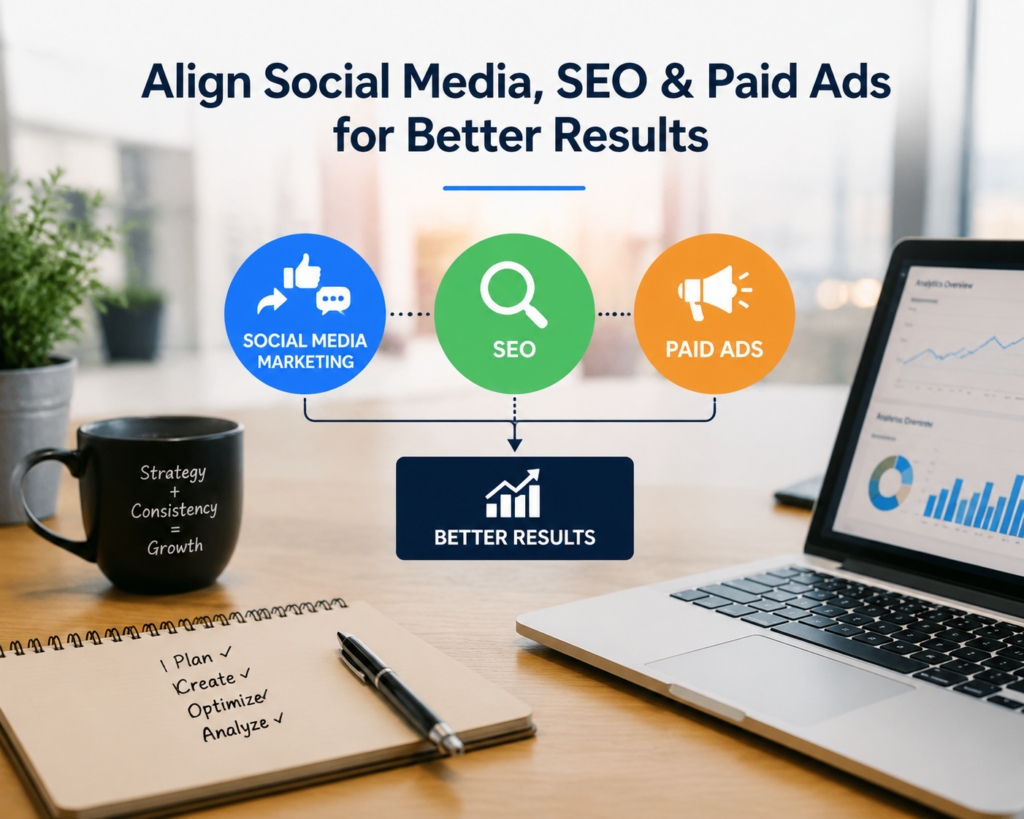
Modern marketing no longer works in silos. Customers move between search engines, social platforms, and ads before making a decision. That is why brands need an integrated approach where Social Media Marketing, search visibility, and paid campaigns work together instead of competing. When aligned properly, these channels improve brand recall, reduce acquisition costs, and increase conversions across every stage of the funnel.
This guide explains how businesses can connect SEO, Paid media ads, and AI-driven search experiences into one unified strategy that performs better in today’s competitive digital ecosystem.
Why Unified Marketing Matters
This section explains why disconnected marketing efforts often fail and how integration creates compounding results across channels.
Social Media Marketing as the awareness engine
Social Media Marketing plays a critical role in building early-stage awareness and emotional connection with audiences. Most users do not convert immediately; they first discover brands through short-form content, reels, or educational posts. When social campaigns are aligned with SEO topics and landing pages, they reinforce messaging consistency across platforms.
For example, a user who sees a brand video on LinkedIn is more likely to search for the same topic on Google later. That’s where integration becomes powerful. According to insights shared by Think with Google Insights, users typically interact with multiple touchpoints before converting, making cross-channel consistency essential.
Pro Tip: Align your content calendar across SEO blogs, social posts, and paid campaigns using the same keyword clusters. This creates stronger topical authority and improves ranking potential across all channels.
SEO is the long-term visibility foundation
SEO ensures that your brand remains discoverable when users actively search for solutions. Unlike social media, which is push-based, SEO captures intent-driven traffic.
A strong SEO strategy ensures:
- Higher visibility in organic search results
- Increased authority in niche topics
- Long-term traffic stability without continuous ad spend
When SEO is aligned with social content and paid campaigns, keyword messaging becomes consistent across all user touchpoints. Google’s official documentation on search quality emphasizes relevance and authority as key ranking signals, which can be explored via Google Search Central.
Paid media ads for instant reach and testing
Paid media ads provide immediate visibility and help businesses validate messaging quickly. Unlike SEO, which takes time, paid campaigns allow rapid experimentation with creatives, landing pages, and audiences.
A well-aligned paid strategy:
- Supports SEO keywords with targeted landing pages
- Retargets social media audiences
- Drives conversions while organic visibility builds
When used together, paid campaigns act as a “traffic accelerator” for SEO and social campaigns, especially during launches or seasonal campaigns.
The AI-Driven Search Evolution
Search behavior is changing rapidly due to AI-powered results, voice search, and generative engines. This shift requires marketers to rethink traditional SEO strategies.
An AI overview is changing how users discover information
AI overview systems now summarize content directly in search results, reducing the need for users to click multiple pages. This means businesses must focus on structured, high-quality, and context-rich content.
To stay visible in AI-generated answers, content must:
- Be structured with clear entities and context
- Answer questions directly and concisely
- Use authoritative and updated information
AEO ensures visibility in answer engines
AEO (Answer Engine Optimization) focuses on optimizing content for AI tools and voice search results. Instead of only ranking on search pages, businesses now aim to be included in direct answers.
AEO improves:
- Visibility in voice search assistants
- Inclusion in AI-generated summaries
- Structured data understanding for search engines
This is where professional AEO Services become important. They help structure content so AI systems can interpret it accurately and feature it in responses.
Building an Integrated Marketing Strategy
This section shows how all three channels work together in a unified system.
|
Channel |
Primary Role |
Supporting Function |
Key Outcome |
|
Social Media Marketing |
Awareness & engagement |
Feeds keyword insights into SEO |
Brand recall |
|
SEO |
Organic visibility |
Supports content for ads |
Long-term traffic |
|
Paid media ads |
Instant traffic & testing |
Validates SEO messaging |
Fast conversions |
|
AI overview |
Discovery layer |
Pulls structured content |
Zero-click visibility |
|
AEO |
Answer optimization |
Enhances AI readability |
Featured answers |
Note: Avoid treating social, SEO, and ads as separate teams. When they operate independently, messaging becomes fragmented and reduces overall campaign effectiveness.
Measurement and Performance Optimization
This section focuses on tracking success across all channels using unified KPIs.
To measure integrated performance, businesses should track:
- Cross-channel conversion rate
- Assisted conversions from social to search
- Organic + paid keyword overlap
- Engagement-to-search lift ratio
- AI visibility mentions
A well-structured analytics system helps identify which channel initiates the journey and which one closes it.
Quick Facts: According to global digital behavior research by Statista Digital Advertising Insights, multi-channel marketing strategies consistently outperform single-channel campaigns in ROI and engagement.
Key Takeaways
- Unified marketing improves visibility across every stage of the customer journey
- SEO builds long-term discoverability while ads drive immediate traffic
- Paid media ads strengthen both testing and conversions
- AI search changes how content is discovered and ranked
- AEO ensures inclusion in AI-generated answers and voice search results
- Consistency across channels increases trust and brand authority
Wrap-Up
Digital marketing success today depends on alignment, not isolation. Businesses that integrate Social Media Marketing, SEO, and Paid media ads create a stronger and more efficient growth system. With the rise of AI-driven search and answer engines, optimization must now go beyond rankings and focus on visibility across multiple discovery layers.
A unified strategy ensures that every interaction—from a social post to a search query to a paid ad—contributes to a single, consistent brand experience.
FAQs
1. Why is integration between SEO and social media important?
It ensures consistent messaging and helps users move smoothly from discovery to search and conversion.
2. How do paid ads support SEO?
Paid ads test keywords, drive traffic to optimized pages, and provide data that improves organic strategies.
3. What is the role of AEO in modern marketing?
AEO helps content appear in AI-generated answers, voice search results, and featured snippets.
Looking to unify your digital growth strategy with expert support? Partner with a trusted Digital marketing agency that understands SEO, paid media, and AI-driven search ecosystems. Explore advanced AEO Services to improve your visibility across search engines, AI platforms, and social channels.