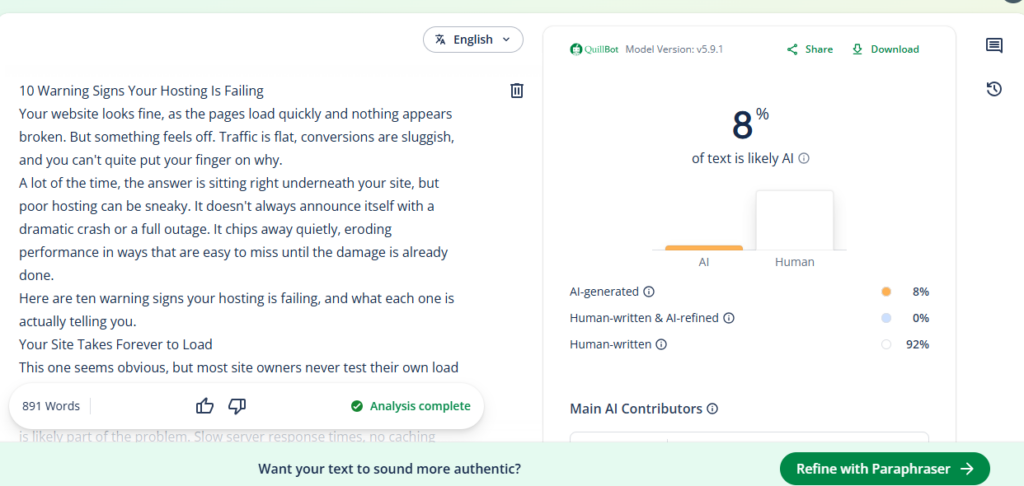


Your website looks fine, as the pages load quickly and nothing appears broken. But something feels off. Traffic is flat, conversions are sluggish, and you can’t quite put your finger on why.
A lot of the time, the answer is sitting right underneath your site, but poor hosting can be sneaky. It doesn’t always announce itself with a dramatic crash or a full outage. It chips away quietly, eroding performance in ways that are easy to miss until the damage is already done.
Here are ten warning signs your hosting is failing, and what each one is actually telling you.
- Your Site Takes Forever to Load
This one seems obvious, but most site owners never test their own load times. Pull up Google PageSpeed Insights or GTmetrix right now. If your site is taking more than three seconds to load, your hosting environment is likely part of the problem. Slow server response times, no caching layer, and weak hardware all show up here. Visitors won’t wait. They leave, and they don’t come back.
- Your Core Web Vitals Scores Are Consistently Poor
Google’s Core Web Vitals measure real user experience across three key metrics: Largest Contentful Paint, First Input Delay, and Cumulative Layout Shift. Poor scores don’t just hurt your user experience. They directly affect your search rankings. If your scores are in the red month after month, your hosting infrastructure is almost certainly a contributing factor.
- Traffic Spikes Bring Your Site Down
A spike in traffic should be exciting. If it’s terrifying instead, that’s a problem. Shared hosting environments are especially vulnerable here. When too many sites on the same server compete for limited resources, even a modest surge can cause timeouts and crashes. A hosting platform worth its cost handles traffic spikes without flinching.
- You Experience Unexplained Downtime
Every host has some downtime. But if yours is happening more than once or twice a year without explanation, that’s not normal. Unexplained outages suggest infrastructure problems, poor redundancy, or overloaded servers. Every minute your site is down, you’re losing visitors, leads, and credibility.
- Your Admin Dashboard Feels Sluggish
When even your WordPress backend is slow to respond, that’s a server-side issue. Logging in takes too long, pages take ages to save, or the media library drags. These are symptoms of a hosting environment that’s underpowered to handle your site’s actual needs. If managing your own site feels like a chore, something is wrong at the infrastructure level.
- You’re Managing Multiple Sites, and Things Keep Breaking
Running one site on a weak hosting plan is manageable. Running five or ten is a different story entirely. Agencies and freelancers managing multiple client websites often hit a wall when their hosting can’t distribute resources properly across sites. One site’s traffic surge slows everything else down. Updates break things unpredictably, and support tickets pile up. This is exactly the scenario that effective hosting for agencies is designed to solve, with dedicated infrastructure, scalable compute, and multi-site management tools that keep everything running smoothly regardless of what any single site is doing.
- Your Security Feels Like an Afterthought
If your hosting plan doesn’t include a web application firewall, DDoS protection, and real-time malware scanning as standard features, you’re exposed. Hosting providers that sell basic security tools as paid add-ons are telling you something about how they’ve built their infrastructure. Reliable hosting treats security as a foundation, not an upsell.
- Support Takes Hours to Respond
When something goes wrong with your site, every minute counts. If your hosting provider’s support response is measured in hours rather than minutes, that’s a structural problem. Worse still is reaching a support agent who doesn’t actually know WordPress or your specific hosting environment. Good support means fast, knowledgeable help from someone who genuinely understands your setup.
- Your Backups Are Inconsistent or Manual
Ask yourself honestly: When did your site last back up automatically? If the answer is “I’m not sure” or “I do it myself when I remember,” you’re one bad update or one hack away from losing everything. Automated daily backups with one-click restore are a baseline expectation from any serious hosting platform. If yours doesn’t offer this, move on.
- You Keep Outgrowing Your Plan
When you upgrade, things improve for a few months, but then the same problems creep back. If this cycle sounds familiar, the issue isn’t the specific plan you’re on but the platform itself. Some hosting environments have a ceiling, and no matter how many times you upgrade within them, you keep hitting it. That’s a sign you need a different infrastructure entirely, not just a bigger version of the same thing.
Final Thoughts: What to Do With This List

Go through each of these honestly. One or two might be acceptable depending on your site’s stage and budget. But if you’re nodding along to three, four, or five of these, your hosting is actively costing you.
The good news is that switching platforms is far less painful than most people expect. Choosing the right web hosting provider can improve performance, security, and scalability while making migration surprisingly straightforward.
The right host handles migration for you, often for free, with no downtime. What takes weeks to fix on a bad platform can be resolved in a single conversation with the right one.
Your site deserves infrastructure that works as hard as you do. Don’t let poor hosting be the thing that quietly holds everything else back.